Segesta from Palermo
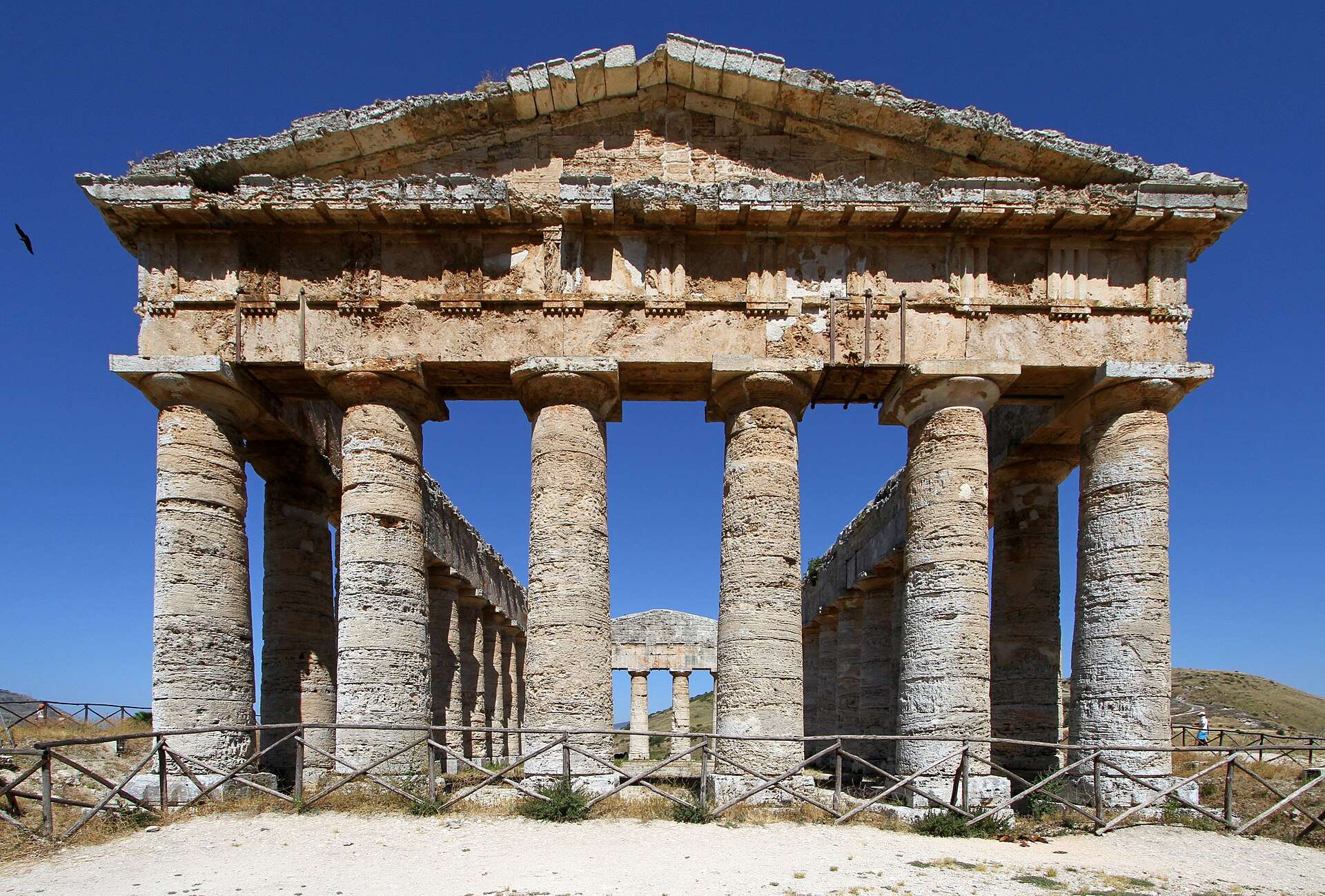
An hour and a quarter west, a temple that looks finished and never was stands alone in the hills — no roof ever raised, columns never fluted — above the theatre of a people who weren’t Greek and built better Greek than most Greeks.
The short version
- Segesta sits about 75 minutes west of Palermo by autostrada with the alarm’s transport honesty in force: the site’s bus links run thin, and the car or tour is the working answer; site information via the regional parks portal at parchiarcheologici.regione.sicilia.it.
- The temple is antiquity’s great unfinished statement: a complete Doric peristyle of the 420s BC — 36 columns standing whole in open country — with no cella traces of roofing, unfluted column shafts, and the lifting bosses still protruding from the stylobate blocks, exactly per the alarm’s stepped-out-for-lunch image.
- The builders were Elymians, not Greeks — western Sicily’s indigenous people, Hellenized by choice and rivalry — raising a flawless Greek-style temple as a statement in their long feud with Greek Selinunte, which is the site’s best story told on its own signs.
- The theatre crowns Monte Barbaro behind the temple — a 3rd-century-BC cavea cut to face away from the city and out over the hills to the Gulf of Castellammare, with the summit shuttle (small fee, regular loops) covering the two-kilometer climb per the alarm.
- Entry runs around the €6–7 mark with the shuttle ticketed separately at the gate; summer evening performance seasons stage classical drama in the theatre — ancient seating, working acoustics, and the sunset doing the lighting design.
- Spring per the alarm is the site’s second spectacle: March through May buries the slopes in wildflowers with the temple rising from the yellow-and-purple wash — the photographs that sell western Sicily are mostly taken in exactly those weeks.

Getting there
The car-or-tour verdict per the alarm is plain arithmetic: the autostrada exit lands nearly at the gate, while the sparse public links (a thin bus schedule and a rural rail halt below the site) turn a half-day into a logistics exercise. Tours from Palermo commonly pair Segesta with Erice or the Trapani salt pans into a full western loop — a legitimate structure that gives each stop its due. The summer-start clause is Sicilian standard: the site is open hillside, and the first hours own the comfort.
The visit
The temple first, alone on its knoll: circle it slowly — the unfluted shafts and the bosses reading clearly at close range, the peristyle’s completeness playing its trick from every angle — and let the unfinished facts reorganize what you’re seeing: a building that was never a building, possibly never meant to hold a god, standing more perfectly than most that did. The wildflower weeks per the alarm turn the circuit into the year’s best photography. Then the shuttle up Monte Barbaro: the theatre’s cavea opens over the hills with the gulf glittering at the horizon — sit high, take the minutes, and note the stage’s outward orientation, scenery as scenography. The summit’s excavation fields (the Elymian city’s agora and mosque-and-castle medieval layers — the hill kept living) reward the walk-around before the shuttle down. The site bar handles the interval; Erice or the coast extends the day for the toured and the driving.
When to go
March through May is the alarm’s wildflower window and the site’s finest hour — temple in the blossom wash, walking weather, and the light still soft. October through April runs comfortable throughout. Summer bakes the open hill and enforces the earliest-start clause, with the compensation of the theatre’s performance season: classical drama at sunset in the original seating, booked ahead, and worth reorganizing a western-Sicily itinerary around. The temple at golden hour — any season — is the closing shot the day was built for.
Frequently Asked Questions
Why was the temple never finished?
The working theory ties it to Segesta’s high-stakes diplomacy: begun in the 420s BC, possibly rushed to impress Athenian allies against Selinunte, and abandoned as wars turned — leaving the peristyle complete and everything else undone. The unfluted columns and lifting bosses are the construction manual fossilized. Whether a roof or cult was ever intended is genuinely debated, which improves the mystery.
Who were the Elymians?
Western Sicily’s indigenous people — tracing themselves, by their own legend, to Trojan refugees — who adopted Greek architecture, coinage, and style while fighting Greek Selinunte for generations. Segesta was their chief city. The temple is their masterpiece of speaking the rival’s language better than the rival.
Is the theatre climb doable without the shuttle?
It’s a two-kilometer paved climb with real grade — 30–40 minutes up for the fit, unlovely in heat. The shuttle’s small fee per the alarm is the standard answer; walkers get the temple views changing behind them as compensation. The theatre itself involves normal ancient-seating scrambling.
Segesta or Selinunte with one day?
The ancient rivals split honestly: Segesta for the single perfect unfinished temple and the summit theatre in a compact visit; Selinunte for a vast scattered city of temple ruins demanding more hours and more imagination. Drama of one building versus sprawl of many — with a car, the ambitious day chains both at the cost of doing either slowly.
Segesta or Monreale from Palermo?
Monreale (documented on this network) for the golden mosaics half an hour out; Segesta for Doric stone an hour-plus west. Byzantine interior versus Greek exterior — Monreale suits the car-free morning, Segesta anchors the driving day, and the week in Palermo owes itself both.