Monreale from Palermo
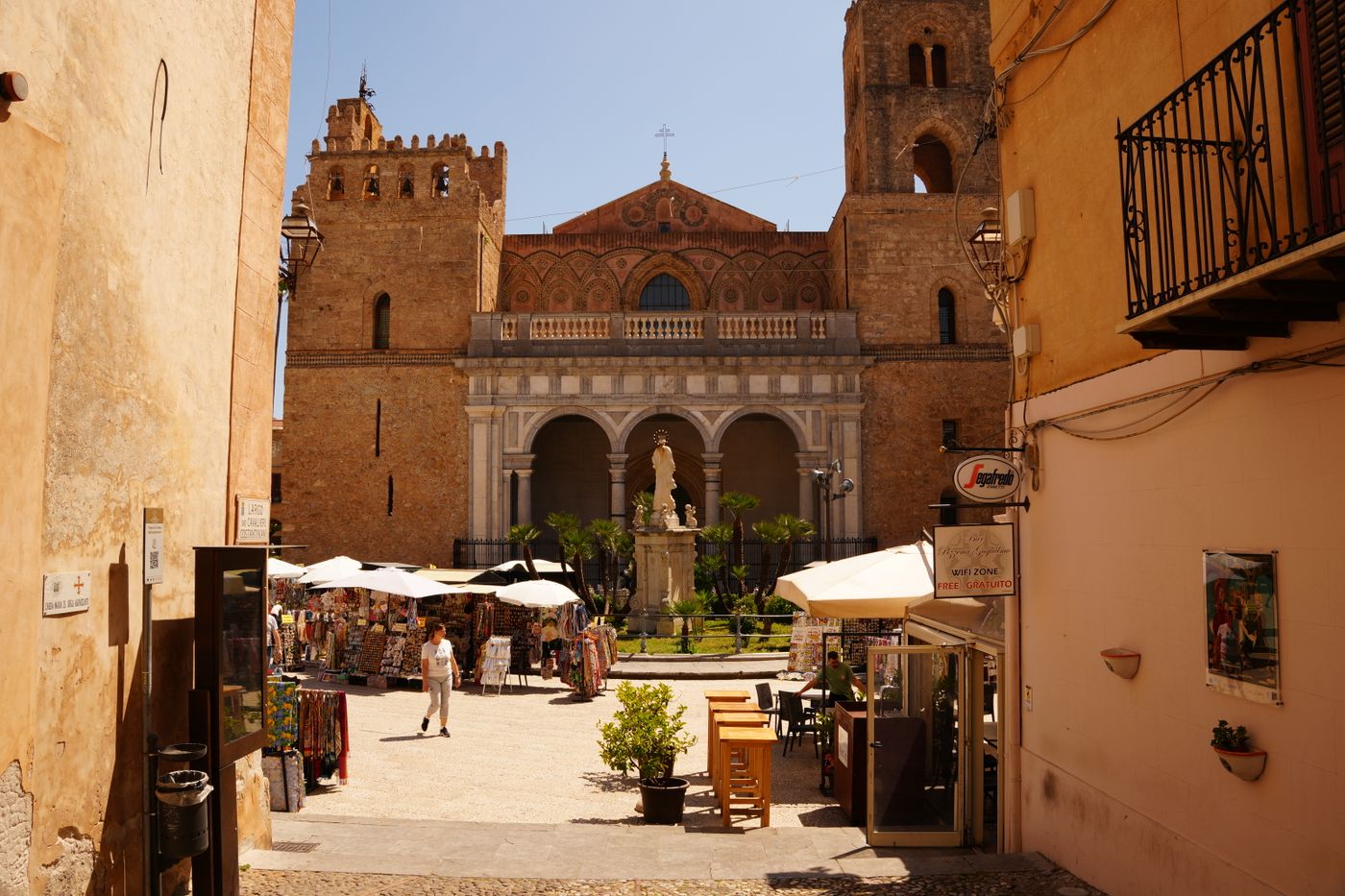
Half an hour into the hills, William II’s cathedral wraps its walls in more gold mosaic than any church in Italy — over six thousand square meters of it. The bus timetable is thin; the dress code is not.
The short version
- The 389 runs from Piazza Indipendenza up to Monreale in 30–40 minutes on city fares — the alarm’s timetable photograph is the day’s one logistics rule; operator information at amat.pa.it, and taxis quote fixed rounds for the impatient.
- The cathedral carries some 6,400 square meters of gold-ground mosaic — the Old and New Testaments run the nave walls in registers, and the apse’s colossal Christ Pantocrator holds the whole building in one gesture.
- The ticket structure splits: the nave enters on donation-level terms, while the roof terraces, treasury, and chapels sell modest separate admissions — and the Benedictine cloister next door, with its 228 paired columns each carved differently, runs its own ticket per the alarm’s endorsement.
- Monreale shares the Arab-Norman UNESCO listing with Palermo and Cefalù — William II’s 12th-century foundation built, by the founding legend, on a dream and a found treasure, and in historical fact on rivalry with Palermo’s archbishop.
- The dress code is enforced at the door: covered shoulders and knees, wraps sold nearby at opportunity pricing — bringing your own is the alarm’s fine print.
- The town around the cathedral runs a terrace-and-granita economy with the Conca d’Oro valley and the sea below — the belvedere behind the apse frames Palermo’s whole bay.
Getting there
Piazza Indipendenza’s 389 stop sits behind the Palazzo dei Normanni — combining Monreale’s morning with the palace and Cappella Palatina’s Palermo afternoon makes the natural Arab-Norman double. The bus climbs through traffic and switchbacks to the cathedral square; the return timetable, photographed per the alarm, decides whether lunch happens up the hill or back in the city. Taxis fill the schedule’s gaps at negotiated-but-standard rates; drivers face the hill town’s parking as their penance.
The visit
Enter the nave and let the eyes adjust: the gold grounds ignite as the light finds them, and the mosaic program reads like a Bible unspooled — Creation through the apostles along the walls, saints in the aisles, and the Pantocrator’s gaze administering all of it. Allow a slow hour with binoculars or a zoom lens for the upper registers. The cloister follows as the change of key: 228 column pairs, no two capitals alike — beasts, vines, biblical scenes, and the famous corner fountain — Romanesque carving at manuscript density, unhurried by the crowds the cathedral absorbs. The roof terraces add the structural view and the bay panorama for their modest ticket. Granita on the square, the belvedere’s look back down the Conca d’Oro, and the photographed timetable’s chosen bus close the visit at half-day length — which is exactly what it wants.
When to go
The mosaics perform year-round with morning light as the multiplier — the gold works best before the sun flattens. Sunday services restrict tourist circulation in the nave; midweek mornings run clearest. Summer heat makes the hill’s shade economy and the cathedral’s stone interior the day’s natural structure; winter offers the gold at its moodiest with the town nearly local-only. Whatever the season, the alarm’s two rules — timetable and dress — are the entire preparation.
Frequently Asked Questions
Monreale or Cefalù for the mosaics?
This network documents both and keeps the verdict consistent: Monreale wins on overwhelming acreage — the full biblical program at cathedral scale — while Cefalù’s apse wins on the single finest face. Half-day pilgrimage versus full coastal day; mosaic completists owe themselves both.
Is the cloister really worth a separate ticket?
Yes, and the alarm already signed it: the carving density has no rival in Sicily, and the relative quiet is part of the value — most bus groups do the nave and leave. An unhurried forty minutes among the columns is the visit’s second masterpiece.
What’s the founding legend?
William II, asleep under a carob tree, dreamed the Madonna revealed his father’s hidden treasure — which funded the cathedral in thanks. The historical version involves out-building Palermo’s powerful archbishop. Both stories are told on site; the mosaics don’t mind which you prefer.
How strict is the dress code?
Consistently enforced — shoulders and knees, both sexes, with the door staff turning away the unprepared toward the wrap vendors. A scarf in the daypack costs nothing and skips the theater.
Can I combine Monreale with Palermo’s own Arab-Norman sites?
It’s the classic structure: Monreale’s morning gold, then the 389 back for the Palazzo dei Normanni and Cappella Palatina’s jewel-box afternoon — the UNESCO ensemble read in one day. The chapel’s smaller mosaics reward arriving with Monreale’s scale still in your eyes.