15 Palermo Hotels, Including the One Where Wagner Finished Parsifal
The Florio family’s Liberty palace on the Acquasanta shore, the hotel where Wagner finished Parsifal and the mafia met in 1957, Lampedusa’s last palazzo, and a tower on the Punic walls where a count still lives.
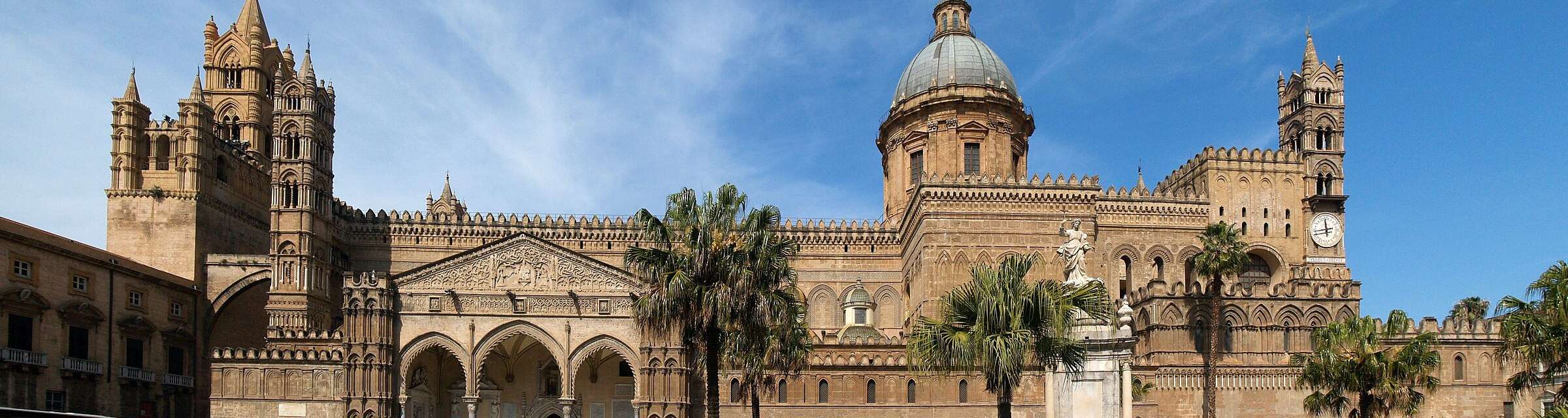
Palermo’s hotels carry the names of the Florios, of Wagner, of Lampedusa and of families who never left their palazzi. This list has Villa Igiea, the Basile-designed palace Ignazio Florio opened in 1900, the Grand Hotel et des Palmes, where Wagner finished Parsifal in 1882 and the mafia met in 1957, Butera 28 in the Palazzo Lanza Tomasi, where Lampedusa wrote The Leopard, and the Palazzo Conte Federico, built around a twelfth-century tower on the Punic walls.
The list is grouped by character, not ranked. Each hotel’s name links to its own site, so you see the current rate and book direct.
Belle Époque grand hotels
Villa Igiea, a Rocco Forte Hotel · Acquasanta
Villa Igiea was commissioned by Ignazio Florio and designed by Ernesto Basile; it opened in 1900 as a hotel after a first plan to run it as a sanatorium was dropped. The Sala Basile keeps Ettore De Maria Bergler’s Art Nouveau frescoes, the best-known Liberty interior in Sicily. It was sold at auction in 2019 after the Acqua Marcia group’s collapse and reopened under Rocco Forte Hotels in June 2021 after a full restoration.
Grand Hotel et des Palmes · Via Roma
The des Palmes was built in 1856 as the Palermo residence of the English wine merchant Benjamin Ingham and converted to a hotel in 1874, with an Ernesto Basile remodel in 1907. Richard Wagner finished the orchestration of Parsifal here in January 1882, and the writer Raymond Roussel died in his room in 1933. In October 1957 American and Sicilian mafia bosses, Lucky Luciano among them, met here over several days. The hotel reopened in 2021 after restoration and is now run by the Sicilian Mangia’s group.
Palazzo Excelsior Palermo · Libertà / Giardino Inglese
The Excelsior opened in 1891 to lodge visitors to Palermo’s Esposizione Nazionale and is the last building from that exposition still standing. It ran alongside Villa Igiea and the des Palmes in the Florio-era Società Grandi Alberghi Siciliani, by the hotel’s account. It traded under Hilton and then Mercure flags before the 2019 auction sale to the Giotti family and its current independent name.
Grand Hotel Wagner · Politeama / Libertà
The Grand Hotel Wagner opened in 2005 inside a restored late nineteenth-century palazzo on the street named for the composer, a block from the Teatro Politeama. It takes its name from Richard Wagner, who spent the winter of 1881 to 1882 in Palermo, and is dressed in Murano chandeliers, marbles and gilded salons in the manner of the Belle Époque grand hotels.
Palazzi still in family hands
Butera 28, Palazzo Lanza Tomasi · Kalsa
Butera 28 is a set of apartments inside the Palazzo Lanza Tomasi, the last home of Giuseppe Tomasi di Lampedusa, who lived here while writing The Leopard. Nicoletta Polo Lanza Tomasi, Duchess of Palma and widow of Lampedusa’s adopted son Gioacchino, runs it and gives cooking classes in the palace kitchen. The palace stands on the old sea walls of the Kalsa facing the Foro Italico, and still holds Lampedusa’s library.
Palazzo Conte Federico · Albergheria / Ballarò
The Palazzo Conte Federico is built around a twelfth-century Arab-Norman tower that stands on the city’s Punic-Roman walls. The Federico family, who still live in it, trace their line to the Emperor Frederick II, by their own account. Count Alessandro Federico, a former racing driver, and Countess Alwine lead the house tours and let apartments to guests.
Palazzo Alliata di Pietratagliata · La Loggia / Via Bandiera
The Palazzo Alliata di Pietratagliata was built in the fifteenth century for the Termine family, with a Catalan-Gothic core and a nineteenth-century neo-Gothic refit. Via Bandiera takes its name from the banners once flown from the palace tower, by the family’s account. It is still the home of the Alliata di Pietratagliata princes, and the princess opens rooms and apartments to guests.
Palazzo Planeta · Politeama / Via Principe di Belmonte
Palazzo Planeta is a set of suites run by the Planeta wine family, one of Sicily’s best-known producers, in a palazzo on the pedestrian Via Principe di Belmonte. It traded earlier as La Foresteria Palermo before taking the Planeta name, and the same company books stays and tastings at the family’s wine estates across the island.
Convent and palazzo conversions in the old city
Grand Hotel Piazza Borsa · La Loggia / Vucciria
The Piazza Borsa occupies the former Mercedarian convent and the building that housed Palermo’s stock exchange on the square of the same name. The convent cloister survives as the hotel courtyard, by the hotel’s account, and it opened as a hotel in 2010 after the complex was restored.
Eurostars Centrale Palace · Quattro Canti / Cassaro
The Centrale Palace occupies the Palazzo Tarallo on Via Vittorio Emanuele, a short walk from the Quattro Canti. The palace dates to the early eighteenth century, by the hotel’s account, and has taken guests as the Hotel Centrale since the late nineteenth century.
Quintocanto Hotel & Spa · Quattro Canti
The Quintocanto stands beside the Quattro Canti, the Baroque octagonal crossroads laid out from 1608. It is set in a seventeenth-century palazzo, by the hotel’s account, with the name playing on being the fifth corner of the four-cornered square. The spa sits in the vaulted cellars.
Palazzo Brunaccini · Albergheria / Ballarò
The Palazzo Brunaccini is an eighteenth-century palazzo on the small square named for Lucrezia Brunaccini, inside the Ballarò market, by the hotel’s account. It was restored and opened as a boutique hotel in the 2000s, one of the first in the market quarter.
Palazzo Natoli Boutique Hotel · Cassaro / Quattro Canti
The Palazzo Natoli is an eighteenth-century palazzo on the Cassaro, the city’s oldest street, a few steps from the Quattro Canti, by the hotel’s account. The rooms keep the palace’s restored frescoed ceilings. The Natoli family’s Natoli Group runs it, along with boutique stays elsewhere in Sicily.
Theatre district and the Mondello shore
Hotel Posta · Via Roma / Teatro Massimo
The Posta has been open since 1921 and run by the same family, by its own account. It was long the hotel of touring actors and companies playing the Teatro Massimo and the Teatro Biondo, and their photographs hang on the walls.
Hotel Villa Esperia · Mondello
The Villa Esperia is a Liberty-style villa in Mondello, the seaside garden suburb an Italo-Belgian company began laying out in 1911, by the hotel’s account. It is a family-run hotel in the villa and its garden, a few minutes’ walk from the beach.
Frequently Asked Questions
Are these hotels ranked?
No. The groups sort them by character, and the order within each group carries no meaning.
What made a hotel interesting enough for this list?
A story. Every entry was a Belle Époque grand hotel with a documented past, a palazzo still in the family’s hands, a convent or palace turned hotel in the old city, or a house with a name attached. Comfort alone did not qualify.
Why are there no prices?
Rates change daily and a priced list goes stale in a month. Each hotel’s name links to its own site, so you see the current rate and book direct.
Is it safe to stay in the old city?
Yes. The Kalsa, the Cassaro and the market quarters around Ballarò and the Vucciria are where most of these hotels sit, and they are busy with locals into the night. Keep a hand on your phone in the markets, as in any southern city, and walk the lit streets after dark.
Which hotel puts me closest to the day trips on this site?
Most day trips from Palermo run to Monreale and Cefalù, to Segesta and Erice, to the Valley of the Temples at Agrigento, or to the Madonie hills. The hotels around Via Roma, the Politeama and the Teatro Massimo sit closest to the coach pickups and the central station.